Post by Barry Kresch
Managed Charging is Collateral Damage From Charging Incentive Cut
It did not take a crystal ball to foresee this outcome: Preliminary indications are that the rate of enrollment in managed charging is down over 50%.
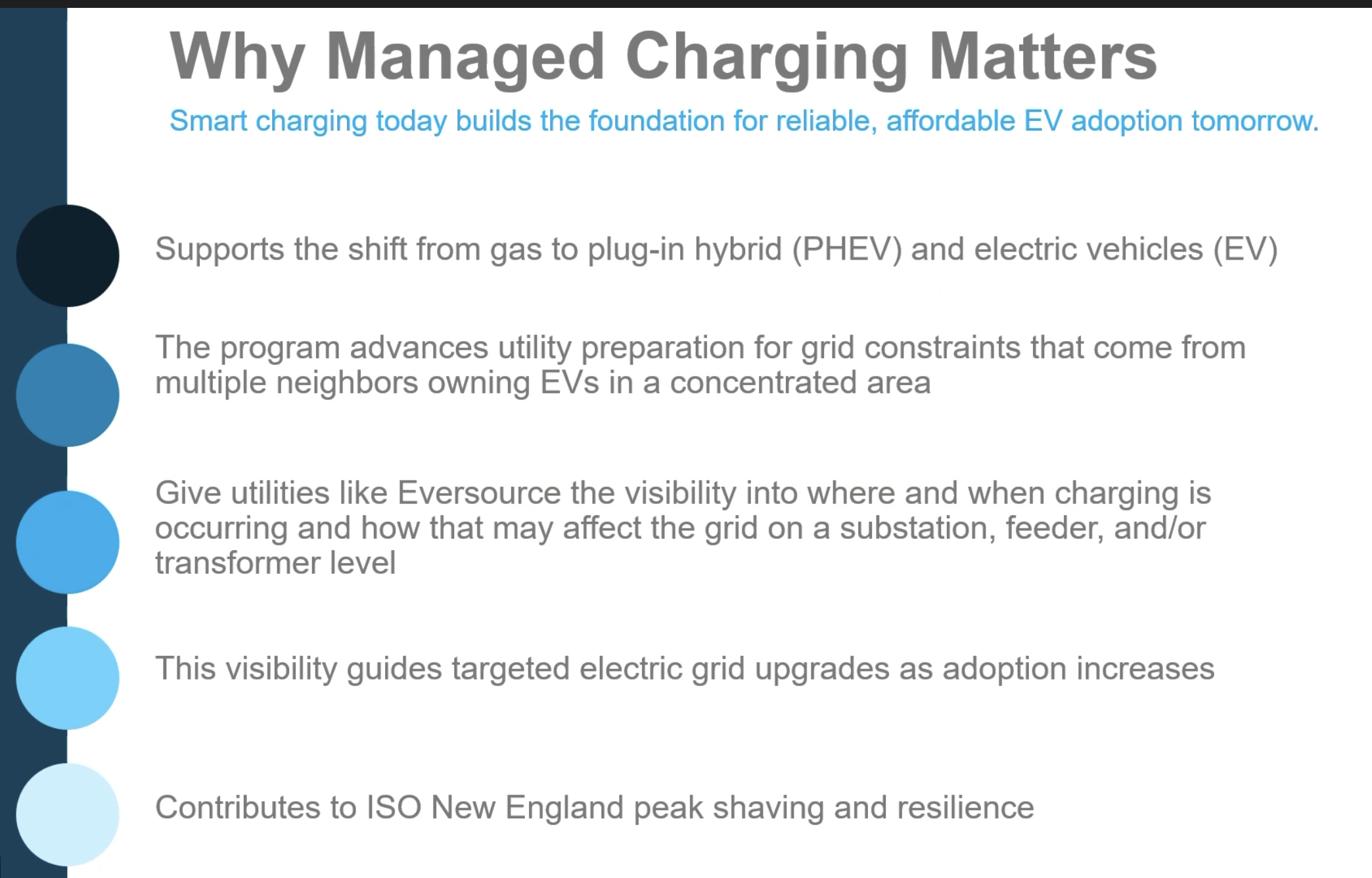
Managed charging is one of several important and relatively new strategies that enable load-shifting, load-shedding, distributed dispatchable energy, and are examples of things that can be done so that electrification of transportation and other sectors does not critically stress the grid. The graphic at the top of the post was prepared by Eversource and speaks to the benefits managed charging.
Loss of Primary Lever to Acquire Enrollees
As we rolled into 2026, the EV charging incentive to offset much of the cost of buying an installing a 240-volt EV charger for single-family homes is now restricted to homes where the household income is no more than 3 times the federal poverty level or is located within a concentrated poverty census tract. This cut came about when the funding was removed from the Combined Public Benefits Charge on the utility bill and moved to being funded by general obligation bonds. When making this change, the legislature cut the funding for the program by about a third and that drove the cuts to the single family incentive. For a detailed description of what happened and why, along with our expectation that this falloff would happen, it is all in this blog post. This applies to Eversource and UI territories.
While it was nice to have an incentive to buy/install a charger, the more important objective of the program was to get people enrolled in managed charging. Enrollment is required for anyone taking the hardware incentive and it pays people an additional incentive to charge during off-peak periods.
This is not the utilities’ doing; It is legislative ready, fire, aim.
The loss of the incentive removed the most effective lever to increase enrollment in managed charging. While the data are preliminary, it appears that the concerns we’ve had are justified. It is not clear if the legislature even thought about these second-order effects when it passed what became Public Act 25-173.
What Can Be Done?
EV owners can enroll in managed charging without getting the incentive if they have a compliant charger or if their vehicle is telematics enabled (i.e. the utility can communicate with it). There is an enrollment incentive of $100. It isn’t much and raising it to $200 or $250 could induce more people to enroll without overly compromising the savings.
I have suggested that a tighter connection be drawn between CHEAPR, the state EV purchase-incentive program, and the managed charging program. It would require the dealerships to become more involved in promoting it. We’ll see if that happens. But DEEP and the utilities are discussing it.
Reporting
After additional data are collected, Eversource and UI will publish the information in the PURA docket that created this program and which requires ongoing reporting. It would be interesting to see 5 quarters worth of data to see how the trend was sequentially affected by the loss of the federal incentive after Q3, and then 3 months later, the change in the charging incentive. The abrupt and steep falloff in January suggests that the charging incentive cut played a significant role.
1 thought on “Managed Charging Enrollment Rate Craters”
Comments are closed.