Rebate Trend Stabilizes
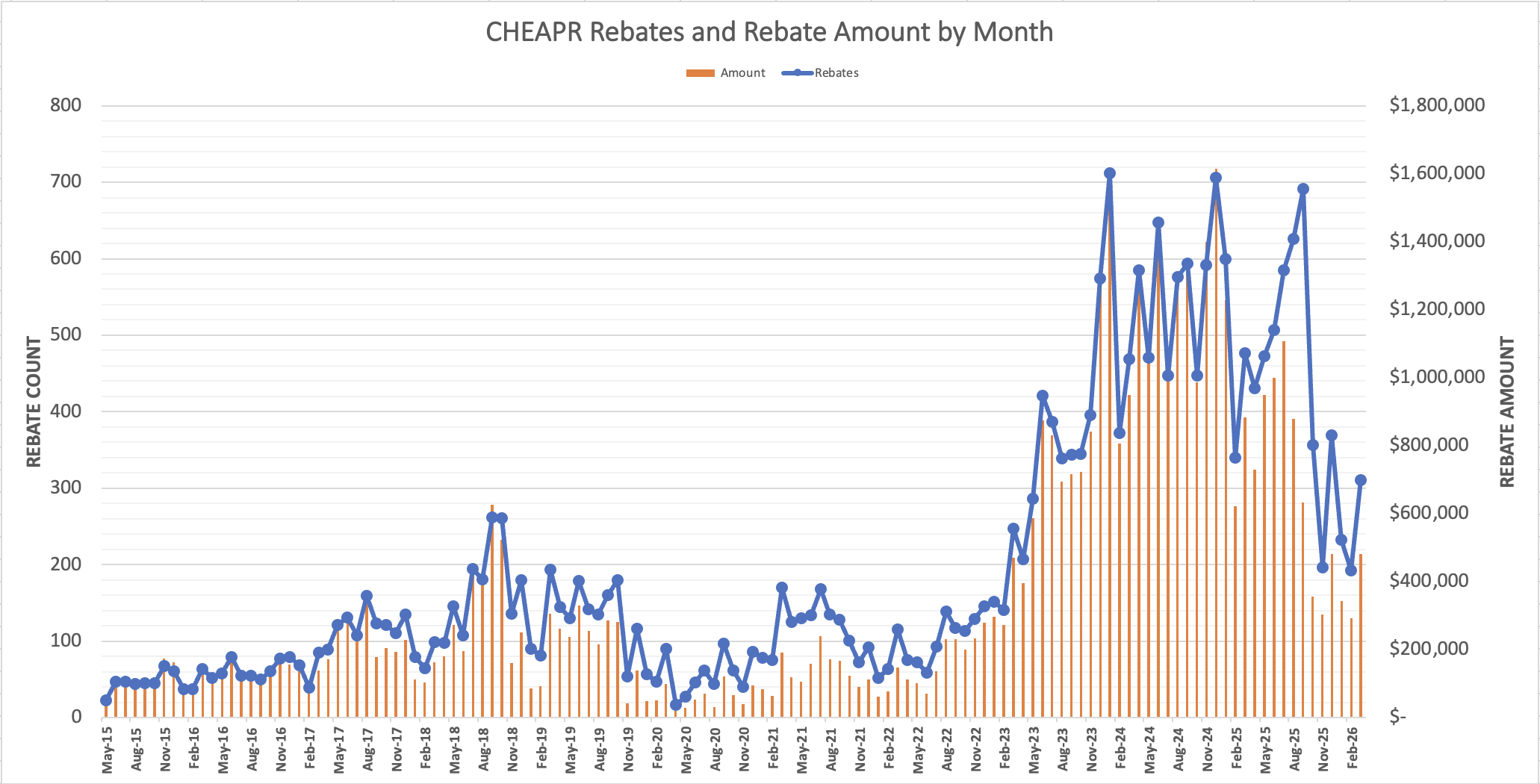
A drop in rebates corresponding to the end of the federal incentive seems to have bottomed out based on the past few months. The chart goes through March and the numbers for the final month or two of the trend typically get restated upward in the next release.
If you look at the chart carefully, you will notice that in recent periods there is a gap between the blue line and the orange bars, indicating that the number of rebates is outpacing the cash disbursements. This is due to the lowering of the standard rebate amount in January, 2025.
This table breaks down the rebates by make. Keep in mind that rebates don’t exactly reflect sales trends as it is limited to qualifying vehicles.

Disposition of 2025 Rebates
The 2025 total of 5730 rebates breaks down into 3 types of rebates:
Standard rebates for new BEVs and PHEVs – 4827 or 84% of the total.
Rebate+ for new vehicles – 712 or 12% of rebates.
Rebate+ for used vehicles – 191 or 3% of rebates.
Eligibility for Rebate+ is restricted to households with income of no more than three times the federal poverty level or those who live in a distressed community, regardless of income.
The statutory language of CHEAPR emphasizes that it should endeavor to maximize Rebate+ in the interest of equity. The Rebate+ new performance has increased over the past couple of years due to the introduction of a pre-qualification voucher, but the rebate levels for used EVs remain stubbornly low. Sales of used EVs overall have been surging, up 12% year over year in the first quarter of 2026, according to Cox Automotive.
Legislative Effort Stalls
Some of us in the advocacy community feel that at least part of the problem holding back used rebates is the restrictiveness regarding which vehicles are eligible. For a used vehicle, it has to have been eligible when new, and it can’t be more than 3 years old. The ostensible reason has been to protect consumers against getting a degraded battery. In our opinion, this is overkill. We proposed having a purchase price cap, similar to how the federal incentive had handled it and be much looser regarding which vehicles could be acquired. EV batteries come with minimum 8-year warranties and, warranty aside, they last a long time. Leave the purchase decision to the consumer.
The legislative bill SB 416 initially addressed these concerns but that language was removed in the final version.
There has also been a proposal for a “Community+” incentive level. This would introduce an intermediate level that would apply to people living in distressed communities who are not income-limited. It would be higher than the standard rebate but lower than the Rebate+. This seems a fair compromise to us and it would modestly reduce the burn rate of the program. That did not get legislative traction either, though it is possible it could be implemented on a rule making basis.
Fleet rebates remain technically a part of the program and were a hopeful item when introduced in the 2021 legislation that relaunched the program. However, the money hasn’t been there to support it. DEEP had been working to acquire some federal funding to at least pilot this, and funds had been approved. But, you guessed it, that all went away with the current administration.