Post by Barry Kresch
Scaling Back the Electric Vehicle Charging Incentive Will Reduce The Ability to Cope with Increasing Electricity Demand
The eligibility for the residential incentive to offset the cost of buying and installing a 240-volt charger has been significantly restricted. It is now only available to households earning no more than 3 times the federal poverty level income threshold or living in a distressed community.
Public Act 25-173, the bill that made the changes, is a poster child for penny-wise, pound-foolish legislation, at least for the EV portion of it. Below is the background on the incentive, the reason for the changes, and why it is a strategic mistake.
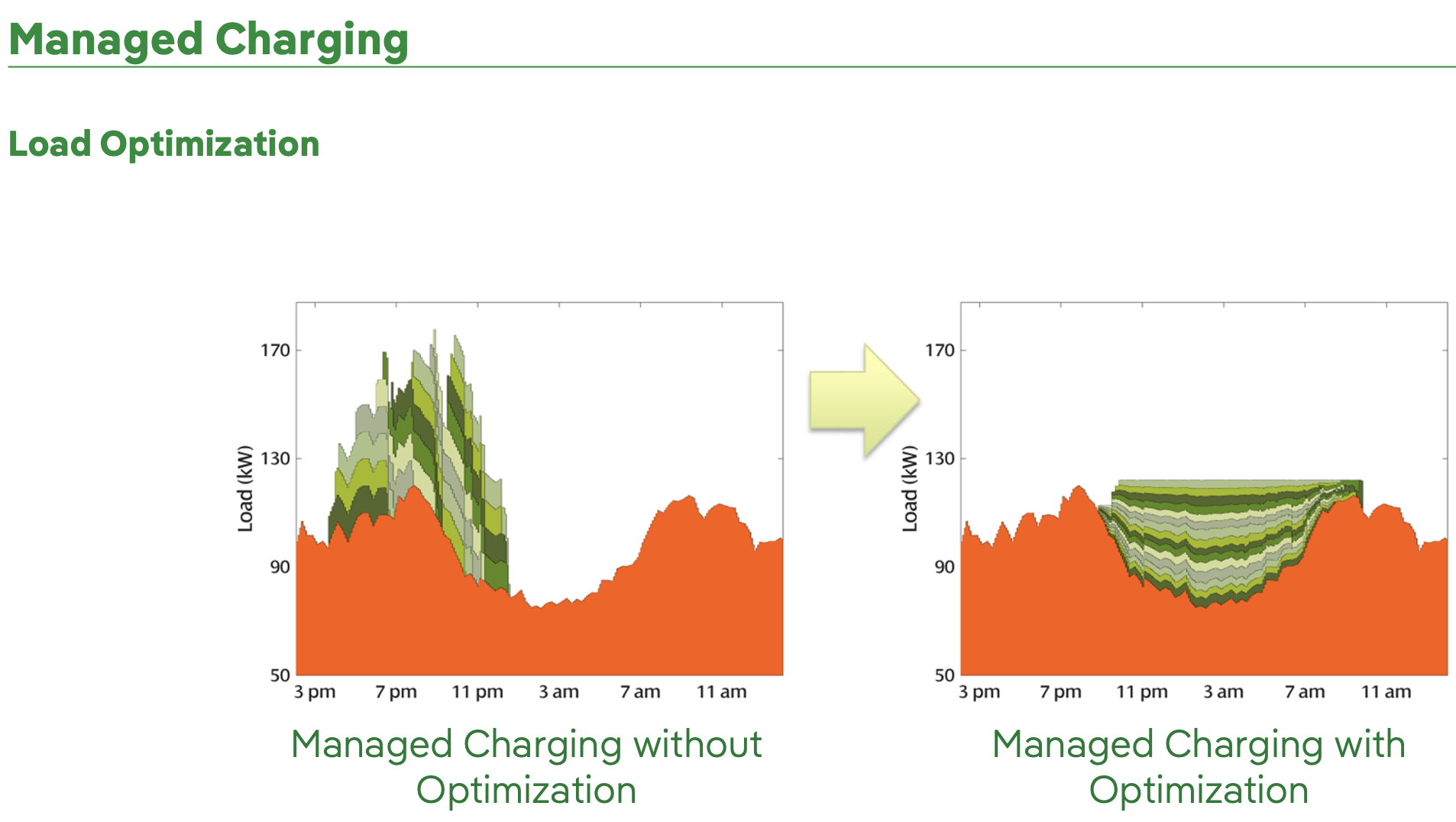
The image at the top of the post is from a United Illuminating presentation at the EV Club’s NorthEast Electric Vehicle Symposium in 2024, illustrating how load shifting mitigates demand peaks. Building for peak demand is what disproportionately drives up costs. More on this below.
Electrify Everything
If we are to be serious about reducing emissions, we must electrify everything (along with greening the grid). That adds up to a lot of potential electricity demand. We are seeing this most acutely in the near term with data centers, but it applies across the board. The challenges are not just about generating the power but having a distribution infrastructure that can handle it, preferably without having to spend a fortune to completely rebuild it. The cost of transmission and local distribution – the poles, wires, and transformers that bring electricity to homes already accounts for a large portion of an electric bill. A recent Eversource bill, where these are itemized as “Transmission” and “Local Delivery,” shows a charge of about 4.3 cents per kWh for transmission and 5.6 cents per kWh for local delivery, or about 9 cents in total, comparable to some of the better generation deals on EnergizeCT. The backbone of our grid is technology that was built a long time ago. There are newer technologies and strategies that can mitigate the amount of upgrades needed, though there is a long way to go in terms of deployment.
EV Electricity Usage
There are 72,737 registered EVs in the state as of January 1, 2026. But what if we get closer to the state goal of 500,000 in a few years, equal to roughly 23% of the state light duty fleet? An EV is like having another appliance in the home. This is appliance-level data compiled by the U.S. Department of Energy from 2020.
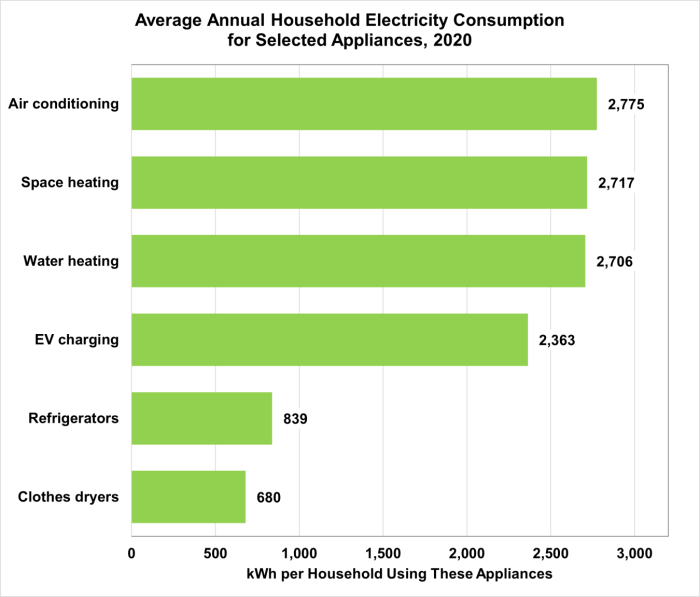
If we take this 2,363 kWh and multiply it by 500,000 EVs, it totals to 1,181,500 MWH. That’s a lot of juice, but using it does not have to stress the grid. The simple reason is that most charging can occur during off-peak periods. And Eversource and UI already pay EV owners to do this. It is called “managed charging,” and it incentivizes EV-owning customers to avoid charging during non-holiday weekdays from 3-9 PM. According to the American Council for an Energy-Efficient Economy (ACEEE), “the fastest and cheapest way to alleviate rapid electric load growth is through expanding investment in energy efficiency and demand flexibility.”
Background on the Eversource and UI EV Charging Incentive
Managed charging was introduced as part of an incentive package that the Public Utilities Regulatory Authority (PURA) approved that took effect in 2022. It offers an incentive of up to $1000 for the purchase and installation of a 240-volt (level 2) EV charger.
There are some rules such as only approved charging equipment being eligible (chargers that have been vetted through an RFQ process). Most importantly, taking the incentive requires participation in managed charging. The managed charging incentive pays either $120 annually for the base level tier or $300 for the advanced tier, which is more automated and involves using an app to set charging times. These are annual incentives. It is also possible to enroll in managed charging without having a compliant charger if the vehicle is able to connect via telematics.
Because Eversource and UI use different back-end vendors, there can be different chargers that are eligible and different vehicles that are telematics eligible. At this time, the charger lists are the same. These lists are changeable. These are the current lists for both utilities.
Eversource Approved Chargers

The EV Club fielded a lot of questions when the program first launched about why the Tesla chargers were not included. The reason was that Tesla had not yet submitted them for approval. All of these are WiFi connected chargers that allow monitoring of charging.
UI Approved Chargers

Eversource Approved Telematics Vehicles
There is a $100 enrollment incentive for telematics participation without getting the charger incentive. There are a lot of EVs slated to be introduced this year. They aren’t on the list at this time but are likely to be in many cases once deliveries begin.


UI Approved Telematics Vehicles


The Most Important Part Of The Incentive
While the headline incentive is $1,000, the big strategic win for the utilities is the load-shifting that comes from managed charging. It is part of a future that also includes distributed generation and dispatchable storage, and is a part of how the grid can be more flexibly managed. A small vehicle to grid pilot program that is just getting started, and the virtual power plant incentive for stationary storage, are other steps toward extending dispatchable storage beyond grid-scale batteries.
Not only does off-peak charging help avoid the necessity of building additional distribution infrastructure, it has the potential to lower ratepayer bills. A study commissioned by the state several years ago conducted by MJ Bradley and Associates, modeled that if EVs become widely adopted and mostly charge off-peak, that revenue could cause the utilities to exceed their permitted rate of return. The overage would be returned to ratepayers.
Public Benefits Charge and Public Act 25-173
The summer of 2024 brought a perfect storm. The Combined Public Benefits Charge (CPBC) of the Eversource and UI bills spiked, mostly due to the Millstone Nuclear Power rate adjustment and the recoupment stemming from the pandemic moratorium on account shut-offs. The CPBC, like the other charges, is billed on a per kWh basis. During a hot summer, when AC use was high, so was the charge. This led to public anger, and of course, the opportunity to turn it into a political football.
For a deeper dive into the details of the CPBC, this is an explainer that was published by the CT Mirror last spring, and includes a description of how the Millstone adjustment works. (It has to do with the cost of the Dominion contract relative to the price of natural gas. There are times when it can lower bills.) This is an excellent video made by Andy Bauer for the CT Energy Network that details many of the good things that are supported by the CPBC, along with another, shorter, video focusing on load-shifting.
The anger of the summer carried into the legislative session in 2025 and from that emerged SB4, which became, upon passage, Public Act 25-173. In part, the bill removed some of what is covered in CPBC and shifted those items to general obligation bonds. It lowers utility bills but the cost is now borne by the taxpayers at large, along with interest charges. One of the items, accounting for a fraction of a cent per kWh, was the EV charging program. In the process, the program sustained cuts. The residential single-family incentive is now restricted to households with an income of no more than 3 times the federal poverty level or those living in concentrated poverty census tracts. (For those who qualify, the incentive amount is now increased from $1,000 to $1,500, the reasoning being a customer pool that is both much smaller and lower income, but the number of allowable chargers has been decreased from 2 to 1 per household.)
The EV charger incentive bonding was for a 2-year period and that is another difference between bonding and CPBC flow-through. It is, for better or worse, subject to frequent legislative renewal decisions, as opposed to the incentive PURA approved that was a 9-year program intended to provide greater marketplace certainty.
The Bigger Picture
The managed charging part of the program remains intact and funded via the CPBC. However, without the ability to enroll people by providing an incentive to offset the cost of an EV charger, the biggest point of leverage to get people into the program is now compromised. The enrollment rate in managed charging will invariably decline.
Again, referencing the ACEEE, “making energy use flexible is a critical way to save money and reduce peak demand. Over the next decade, deploying load flexibility measures—like shifting EV charging or most water heating to off-peak times—could reduce peak demand by 60 to 200 gigawatts, an amount up to double the most aggressive projections of total U.S. data center capacity by 2030…”
The EV charging incentive that was developed by PURA, and which the utilities have been publicly supportive of, had this bigger-picture thinking in mind. As we move into this election year legislative session, where affordability is top of mind, the CPBC, even in its shrunken form, is already a subject of discussion, including proposals to dispense with it entirely. You need a microscope to see the cost of the managed charging program. Per Eversource, it is $0.000128/kWh.
The Head of the CT Office of Consumer Counsel, Claire Coleman, was quoted in the CT Mirror speaking about the Public Benefits Charge broadly and was spot-on when she said, “While it is appropriate for state leaders to focus on energy affordability, reactive proposals to disinvest in the reliability of our electric grid, cost-effective energy resources or important affordability initiatives risk not being in the best interest of ratepayers.”
Eversource is holding a webinar about the current status of the residential charging incentives on February 27th at noon. Register here. The Eversource and UI programs are the same, except, as noted earlier, for potential differences in approved equipment due to different vendors.