

Bill HB 5568 Would Impose Added Registration Fees on Plug-in Vehicles
The proposed fees are $345 for 3 years for all battery electric vehicles (BEV), range extended electric vehicles (EREV), and fuel cell vehicles (FCEV). Plug-in hybrids (PHEV) would be taxed at a rate of $233 for 3 years. The current registration fee is $120 for 3 years.
The EV Club opposes this tax. Our reasons have to do with timing, context, and fairness.
Transportation Fund
These fees have been imposed in some other states as a way to ostensibly cope with shortfalls in the transportation fund resulting from BEVs not paying any gas tax. This is an extremely exaggerated assertion.
There are about 73,000 EVs registered in CT, breaking down to about 47,500 BEVs and 27,500 PHEVs, and compares to about 2.3 million total registered light duty vehicles. In other words, 3.2% of the fleet is electric, though it is only 2% if we restrict it to BEVs. It is simply too small at present to matter.
The transportation fund is in surplus, though there are forecasts that, depending on borrowing levels, the fund could face deficits in about 5 years. This will have to be addressed, but it is not an emergency.
Why is There a Potential Funding Shortfall
The reasons for a projected shortfall are improvements in fuel efficiency of internal combustion engine (ICE) vehicles and choices made (or not made) by the legislature.
The federal Corporate Average Fuel Economy (CAFE) standards, augmented by the more stringent California Air Resources Board (CARB) standards, have led to an improvement in fuel efficiency of almost 40% over the past 25 years.
While construction costs were rising and ICE vehicles were consuming less fuel, gas taxes were not indexed to inflation or raised in any way. There are two parts to the gas tax. The first is an excise tax of 25 cents, which was last increased in 2000. The second gas tax is the gross receipts tax, which stands at 8.1% of the wholesale price and was last adjusted in 2013. While the gross receipts tax, being a percentage, can vary, it is roughly the same amount as the excise tax. There are some other sources of funding, including a portion of the sales tax and federal funding, which comes and goes, and was more generous a couple of years ago.
Also, lest we forget, we used to have tolls (ended in the ’80s). And a gas tax holiday (excise only) in 2022 during the post-Covid inflation spike.
For general comparison, out of the 38 Organization of Economic Development and Cooperation (OECD) member countries, the USA average gas tax ranks second lowest (Mexico is the lowest). The European countries tax gas at 2-4 times what the USA does. Canada is about 4X the USA.
Terrible Timing
The proposal comes at the worst possible time. As of this writing, the war with Iran is in its 26th day with no clear indication of how long it will last. The Strait of Hormuz is still closed. Oil and gas facilities in the greater Persian Gulf area are being damaged. Wells are being taken offline since shipping is blocked and storage is full. Gas prices are spiking.

These high prices are likely to be with us for a while, even after a cease-fire occurs. As the St. Louis Fed explains, oil and gas prices often rise in sync, but gas prices tend to fall more gradually (they have called it “rockets and feathers”). It takes time to repair infrastructure, restart wells, and in general put Humpty Dumpty back together.

EV Policy Headwinds
EVs, along with other renewables, enable us to mitigate the impact of oil price shocks. Most of the readers of this blog are EV owners and will not be feeling the pain at the pump. More EVs would protect more people, including drivers of ICE who stand to benefit from lower demand.
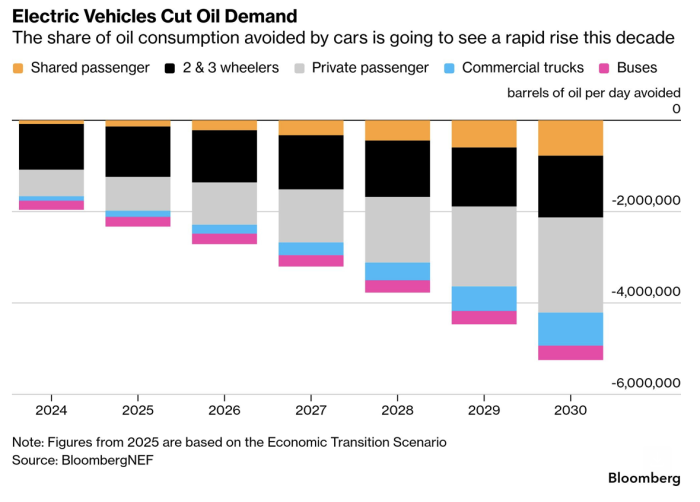
This tax will slow EV adoption. A study done by the University of California at Davis estimated that a $100 fee reduces EV demand by 10%. EVs are already contributing to a significant amount of avoided oil consumption. According to Bloomberg New Energy Finance, this will amount to about 2.5 million barrels per day (worldwide). It could be a lot higher.
The EV policy arena is already dealing with a challenging landscape. The federal incentive is gone, but we haven’t done that well at the state level either. The CHEAPR incentive is still around but the standard BEV incentive is 55% lower than it was 15 months ago. The eligibility for the single-family residential dwelling incentive to install a 240-volt EV charger has been greatly restricted. That came about when it was moved from the public benefits charge to general bonding, and it is reducing the enrollment rate for managed charging. (That whole sordid story can be found here and here.) Looking back further, the state did not pass the Transportation Climate Initiative or join the second phase of the CARB rules. It is fair to wonder how seriously all of the net-zero resolutions and statutes are being taken.
We should be doubling down on EVs, not discouraging adoption. A BEV has zero tailpipe emissions. If there are a lot of them, it improves air quality, which reduces with the incidence of cardio-pulmonary illness and cancer. Zero-emissions also means no greenhouse gases. Just because the costs of global warming are indirect, it doesn’t make them any less real, not to mention very expensive.
Is This a Well Designed Tax
When someone buys an ICE vehicle, they can influence their gasoline expenditures based on fuel-efficiency and their utilization. This proposed tax is a simplistic one-size fits all design.
EVs should contribute to the maintenance of our transportation system, but in a way that acknowledges the damage that burning fossil fuel causes. This is something that should be thought through and modeled. For example –
- At what level of EV adoption should we begin to phase in some kind of tax?
- There are other options besides registration fees being tried in other states. What have we learned from the results?
- The current gas tax level is not sacrosanct. It should be raised.
- According to Cox automotive, the purchase premium for a new EV sits at $6500. That means EV owners pay an extra $413 to buy an EV at the standard sales tax or $503 if the vehicle is subject to the luxury tax. EV drivers using public charging in the state pay sales tax on the juice (gas has no sales tax).
- A holistic design should take these factors, and the multiple levers available into account.